
The car is dead on a Monday morning for the second time this month. Or the dash cam you wired in last weekend never switches off. Or one taillight works and the other does not, and the bulb looks fine. Each of these can turn into an expensive afternoon at a shop, and each one can usually be narrowed down in fifteen minutes with a meter that costs less than a tank of gas.
A multimeter does not fix anything by itself. What it does is replace guessing with numbers: is the battery charged, is the alternator charging, is power reaching this plug, is something draining the battery overnight. This guide covers the handful of tests that solve most car electrical problems, what to look for in a meter, and three meters for three kinds of owner.
Disclosure: GarageWise is reader-supported. As an Amazon Associate we earn from qualifying purchases, at no extra cost to you.
The four tests that solve most problems
1. Battery resting voltage
Set the meter to DC volts (the V with a solid and dashed line). If it is manual-ranging, pick the 20 V range. Red probe on the positive terminal, black on the negative. If the number shows a minus sign, your probes are swapped.
Test after the car has sat for at least an hour, or better, overnight. Haynes puts a healthy battery at about 12.6 V at rest; 12.2 V is only around half charged, and under 12 V counts as discharged. A reading right after a drive will look better than the battery really is, because of the surface charge from the alternator.
2. Charging voltage
Start the engine, keep fingers, sleeves and leads clear of the belts and fan, and measure across the battery again. Haynes gives 13.8 to 14.4 V at idle as the healthy range. Lower than that and the battery is not being charged properly; much higher and the system is overcharging, which cooks batteries. Some newer cars with smart charging vary this on purpose, so check your service information if a reading looks odd but the car behaves normally.
3. Voltage at the problem
For a dead light, horn or accessory, the question is whether power is getting there. Unplug the connector, switch the circuit on, and put the black probe on a clean ground (bare metal or the battery negative) and the red probe in the power terminal. Battery voltage there means the wiring is fine and the part is bad. Nothing means the problem is upstream: a fuse, a relay, a switch or a broken wire.
Continuity mode, the one that beeps, is the next step. With the circuit unpowered, it tells you whether a fuse, bulb filament or length of wire is actually connected end to end. Never test resistance or continuity on a live circuit.
4. Parasitic draw
This is the test for a battery that keeps going flat. Fluke’s guide to finding battery drain lays out the method: turn everything off, close the doors, and let the car sit (anywhere from 10 to 45 minutes) so the control modules go to sleep. Then disconnect the negative battery cable and connect the meter in series between the post and the cable, on the amps setting, starting in the 10 A jack.
Once the reading settles, a draw over roughly 100 mA after the car is asleep is worth chasing. Pull fuses one at a time until the number drops, and you have found the circuit. Fluke also flags the usual suspects: aftermarket alarms, stereos and dash cams. Never crank the engine or switch on headlights while the meter is in the circuit, because that current goes through the meter.
If a dash cam is your suspect, our guide to hardwiring a dash cam without draining the battery covers the fuse-tap side of it.
Specs that matter on a car meter
- DC volts with good resolution. The difference between 12.6 and 12.2 V is the difference between a full battery and a half-empty one. Any meter does this, but a clear, backlit display helps under a hood or a dashboard.
- 10 MΩ input impedance. High impedance means the meter barely loads the circuit it is measuring, which matters on sensor and computer circuits. Innova and Fluke both list it for their automotive meters.
- A milliamp range. Parasitic draw is measured in tens of milliamps. A meter with only a 10 A current range will show you something, but not with much precision.
- Fused current inputs. Putting the probes in the amps jack and then touching a battery is the classic beginner mistake. A fused input costs you a fuse; an unfused one can cost you the meter.
- Auto-ranging is a convenience, not a necessity. Manual ranging is fine once you know which range to pick, and it is often a little cheaper.
Specs you can mostly ignore
CAT IV ratings, thousand-volt ranges and true-RMS are important to electricians working on building wiring. On a 12-volt car they mostly do not come into play, though a hybrid or EV high-voltage system is a different story and best left to trained techs. Capacitance, temperature and frequency are nice extras, and RPM, duty cycle and pulse width only matter if you plan to test sensors and injectors.
Quick checklist before you buy
- Will you mostly check batteries, fuses and bulbs? Any decent basic meter works.
- Chasing a battery drain? Get one with a milliamp range and fused inputs.
- Planning to test sensors, injectors or ignition? Look for duty cycle, RPM and pulse width.
- Working in the dark under a dash? A backlight and a way to hang or stand the meter matter more than you would think.
Three meters for three kinds of owner
For battery checks and fuse hunting: Klein Tools MM325
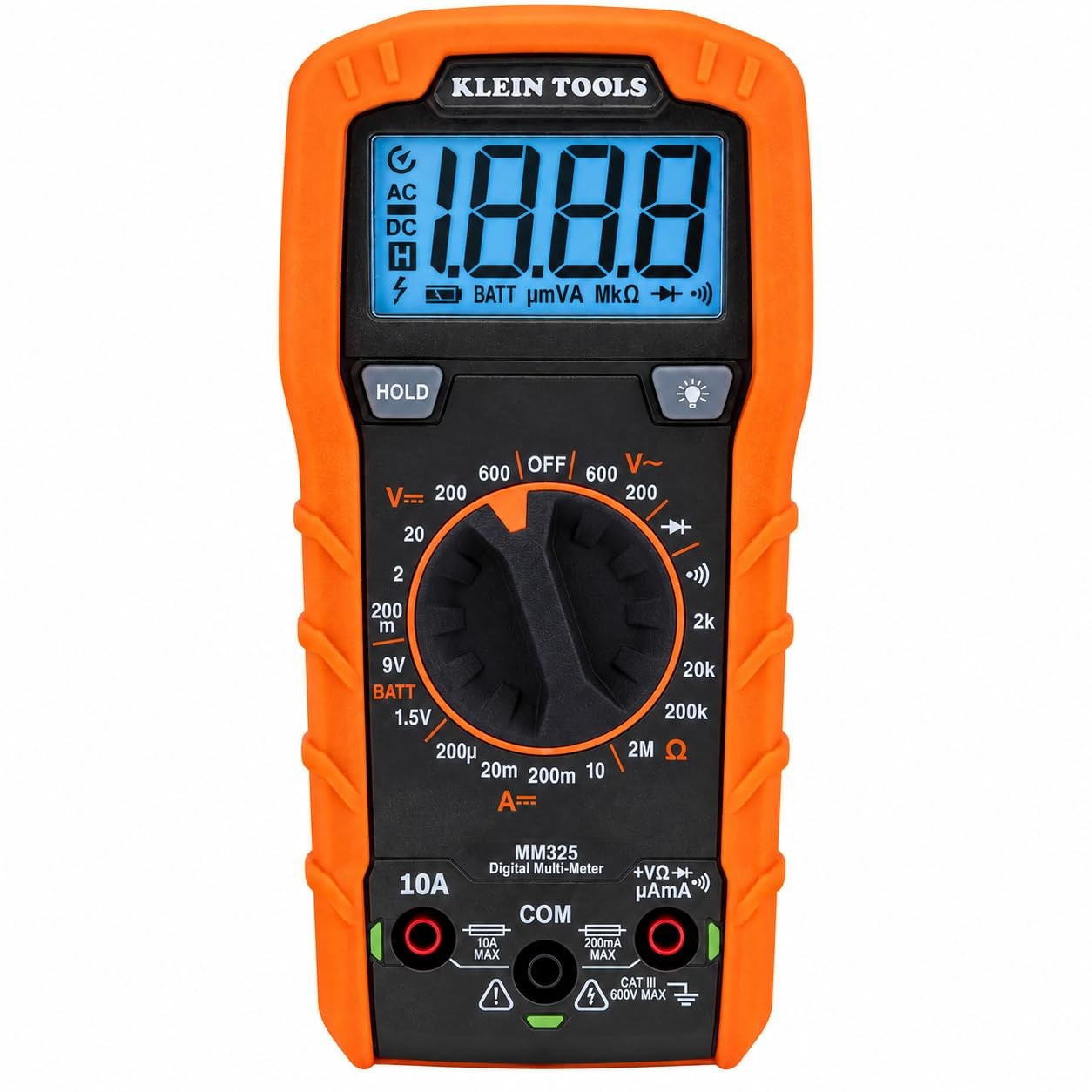
If your electrical work is mostly checking the battery, finding a switched fuse for a dash cam and seeing why a trailer light is dead, the MM325 covers it without paying for features you will not use. Klein lists it at 600 V AC/DC, 10 A DC and 2 MΩ, with battery, diode and continuity tests, a backlit display and a 6.6-foot drop rating.
It is manual-ranging, so you choose the range on the dial, and its Lead Alert LEDs show which jacks the test leads belong in. That is handy if the meter lives in a drawer and comes out a few times a year. What it lacks is a dedicated milliamp scale for fine parasitic-draw readings; you can still spot a large drain on the 10 A range, but small ones will be hard to read.
Mostly testing batteries and fuses? The MM325 is a tough, no-fuss meter that does the basics well.
See the Klein MM325 on Amazon →For the home mechanic: Innova 3340
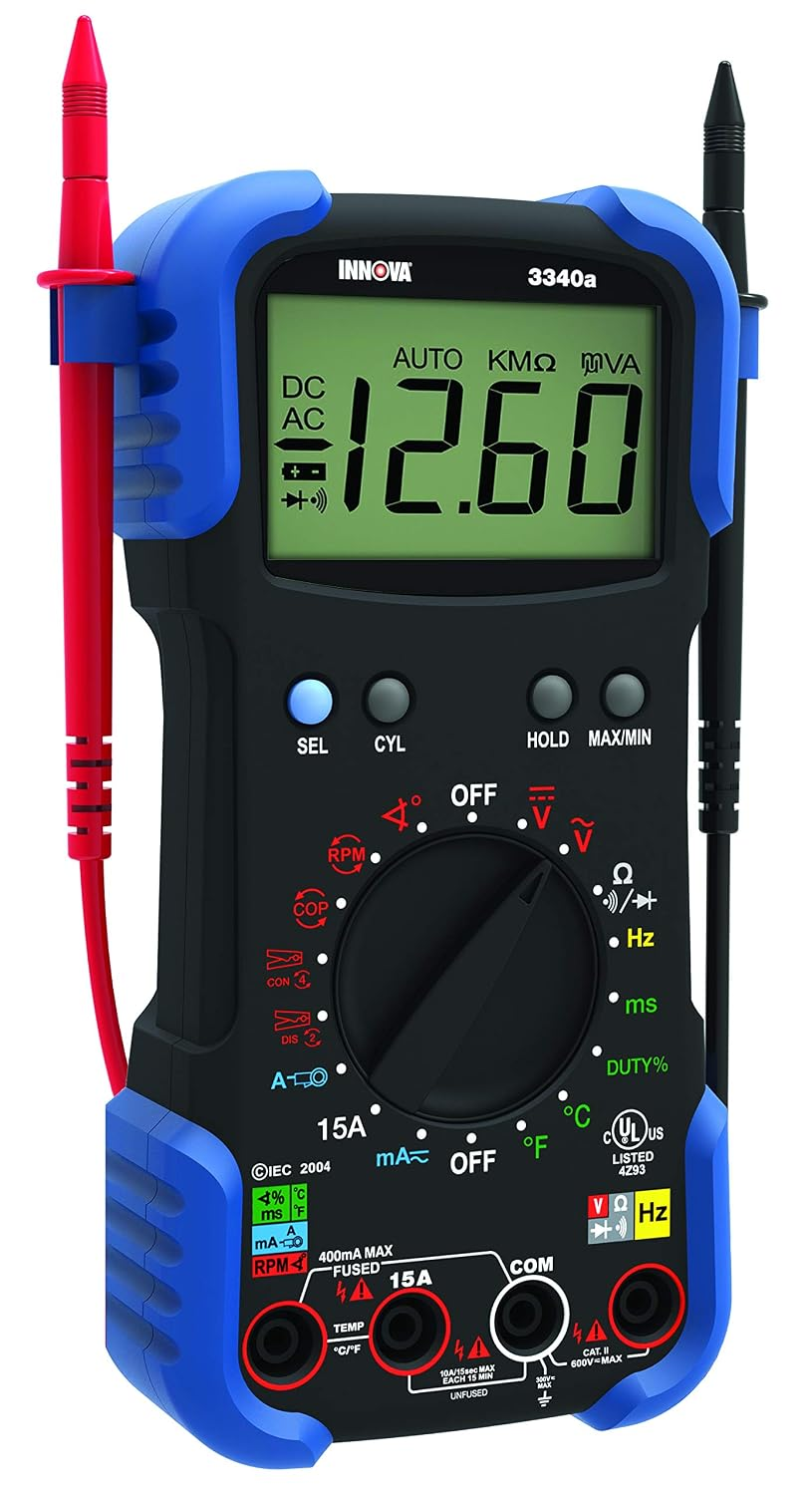
The 3340 is built around car work. Innova’s Amazon listing describes it as auto-ranging with auto shut-off and overload protection, 10 MΩ input impedance that is safe for vehicle computer circuits, and current measurement up to 15 A. It tests alternator diodes, duty cycle, solenoids, switches and wiring.
The useful extras come in the box: a temperature probe, an inductive RPM clamp and a carrying case. The dial also has a milliamp setting, which is what you want for a parasitic-draw test. For someone who does their own maintenance and wants one meter that grows with them, this is the sweet spot.
Want one meter that does the car stuff? The Innova 3340 adds RPM, duty cycle and a temperature probe to the basics.
Check the Innova 3340 price →For serious diagnostics: Fluke 88V/A combo kit
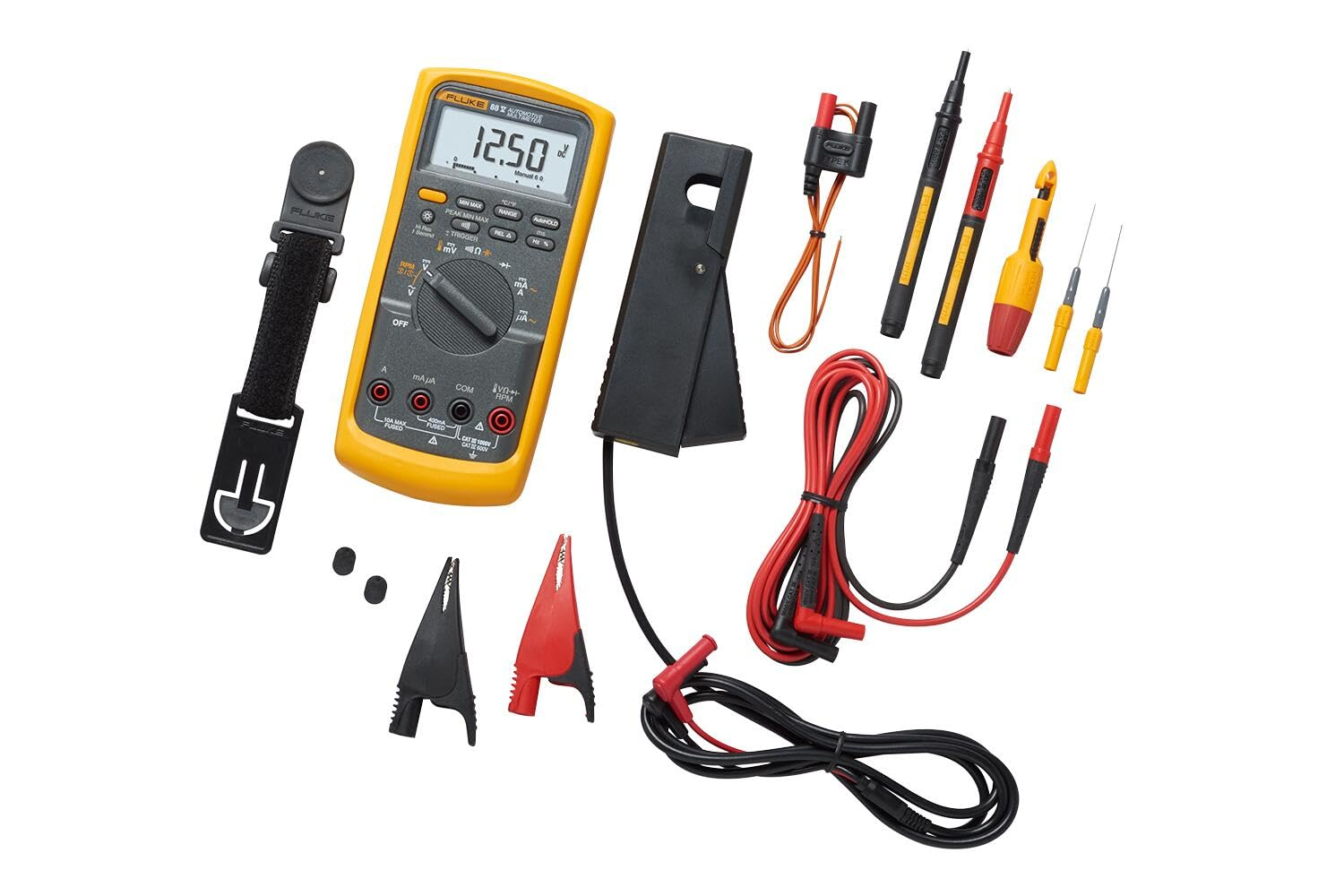
The Fluke 88V is the automotive meter many professional techs carry. Fluke lists voltage to 1000 V AC/DC, current to 10 A (20 A for up to 30 seconds), 10 MΩ input impedance, millisecond pulse width for fuel injectors, duty cycle, Min/Max/Average recording and a bright two-level backlight. It is rated CAT III 1000 V and CAT IV 600 V, and Fluke backs it with a limited lifetime warranty.
The 88V/A kit bundles the meter with a selection of test leads, clips, probes and a current clamp, so you do not need to piece together accessories later. It is a large investment for a home garage, though. Buy it if you are diagnosing intermittent faults, chasing sensor signals or doing this for a living; otherwise one of the meters above will do everything you need.
Doing real diagnostic work? The 88V records min and max values so you can catch a glitch you would otherwise miss.
View the Fluke 88V/A kit →A few habits that keep you and the car safe
- Check where the leads are plugged in before every test. Volts jack for volts, amps jack only for current tests.
- Never measure resistance or continuity on a powered circuit.
- Keep jewelry, tools and loose metal off the battery top. A wrench across both terminals is a shower of sparks.
- Leave orange high-voltage cables on hybrids and EVs alone.
- If you disconnect the battery, have any radio security code to hand before you reconnect it.
Once the meter tells you the battery is the problem, our guide to battery chargers and maintainers will help you decide whether it needs charging, maintaining or replacing. And if a warning light is part of the picture, a code reader from our OBD2 scanner roundup is the other half of the toolkit.