
You walk out to a car that has been sitting for three weeks, turn the key, and get a single sad click. Or nothing at all.
That is the moment most people start shopping for a battery charger. The better question comes first, though: do you need a charger, a maintainer, or neither? Plenty of drivers never need one. Some people need one badly and don’t know it.
Here is how to tell which group you are in, what to look for on the box, and four chargers that cover almost every garage.
Disclosure: GarageWise is reader-supported. As an Amazon Associate we earn from qualifying purchases, at no extra cost to you.
Charger, maintainer, trickle charger: what is the difference?
The words get used loosely, so it helps to pin them down.
- Battery charger: puts a meaningful amount of current into a flat or low battery to bring it back up. Think 4 to 10 amps for a car battery.
- Battery maintainer: a low-current smart charger that tops the battery up, then drops to a float or monitoring mode and holds it there for weeks or months.
- Old-style trickle charger: pushes a small constant current whether the battery needs it or not. Left on long enough, it can overcharge. Most modern “trickle chargers” are really smart maintainers, which is what you want.
Every product below is a smart charger. Each one charges, then switches to maintenance on its own, so you can leave it connected.
Who actually needs one
A car battery loses charge slowly even when nothing is switched on. Alarm systems, keyless entry receivers and the computers in newer cars all draw a little current around the clock. Daily driving puts that back. Sitting doesn’t.
You probably need a maintainer if any of these sound familiar:
- The car regularly sits for two weeks or more: a second car, a weekend convertible, or a car parked while you travel.
- You store a motorcycle, lawn tractor, boat or ATV over winter.
- Most of your trips are short, especially in winter, so the alternator never gets a long run to recharge.
- You live somewhere cold. A battery has less to give on a freezing morning, and a partly charged one is the first to fail.
- You have added accessories that draw power when parked, like a hardwired dash cam.
- The battery is getting old and you want to squeeze out another season.
And you can probably skip it if you drive most days for 20 minutes or more and the battery is healthy. In that case, a jump starter in the trunk is a better use of the money.
Specs that matter (and a few that don’t)
Amps versus battery size
The amp rating decides how fast a charger can refill a battery and how big a battery it can realistically charge. A 1-amp unit is fine for keeping a car battery topped up, but slow at reviving a flat one. For a full-size car or truck battery that actually runs down, 4 to 5 amps is the practical sweet spot.
Manufacturers usually list a capacity range in amp-hours (Ah). Check it against your battery label.
Battery chemistry
Most cars still use flooded lead-acid, AGM or EFB batteries. Many stop-start cars use AGM. Some motorcycles and lightweight setups use lithium (LiFePO4), which needs a charger that supports it. If you own anything with a lithium battery, check this line first.
Temperature compensation and dead-battery recovery
Correct charging voltage changes with temperature. A charger with a built-in temperature sensor adjusts for a cold garage in January and a hot one in August. It’s worth having.
Many smart chargers also refuse to start on a deeply drained battery because they can’t detect it. Some have a manual override for that situation. Useful if you are rescuing batteries, less important if you plan to keep one from ever going flat.
Ring terminals
A maintainer that comes with an eyelet or ring-terminal lead lets you bolt a short pigtail to the battery once and plug in each time you park. On a motorcycle or a tractor with a buried battery, that convenience is the difference between using it and not.
What to ignore
Big “repair” and “desulfation” claims are marketing-heavy. These modes can help a battery that has been sitting low, but they won’t bring back one that is genuinely worn out. Buy for the basics above.
Four picks at a glance
| Charger | Best for | Output | Battery range | |
|---|---|---|---|---|
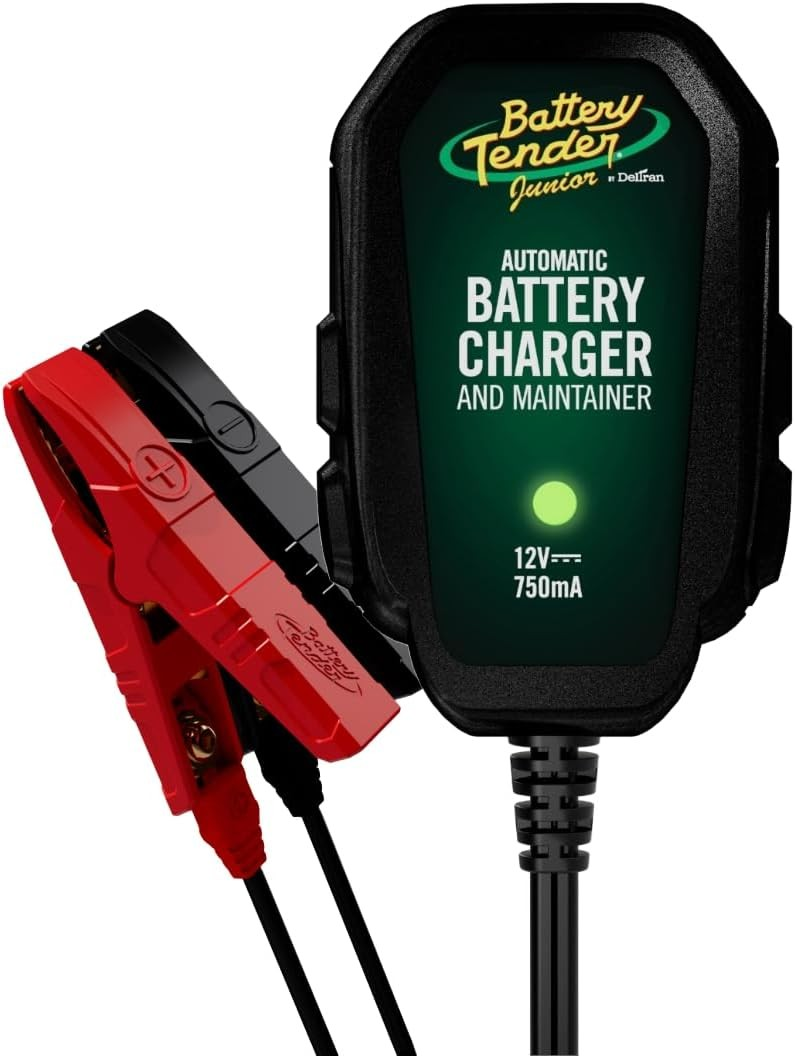 Battery Tender Junior (021-0123) | Motorcycles, mowers, ATVs in storage | 12 V, 750 mA | 3 to 30 Ah | Check Price |
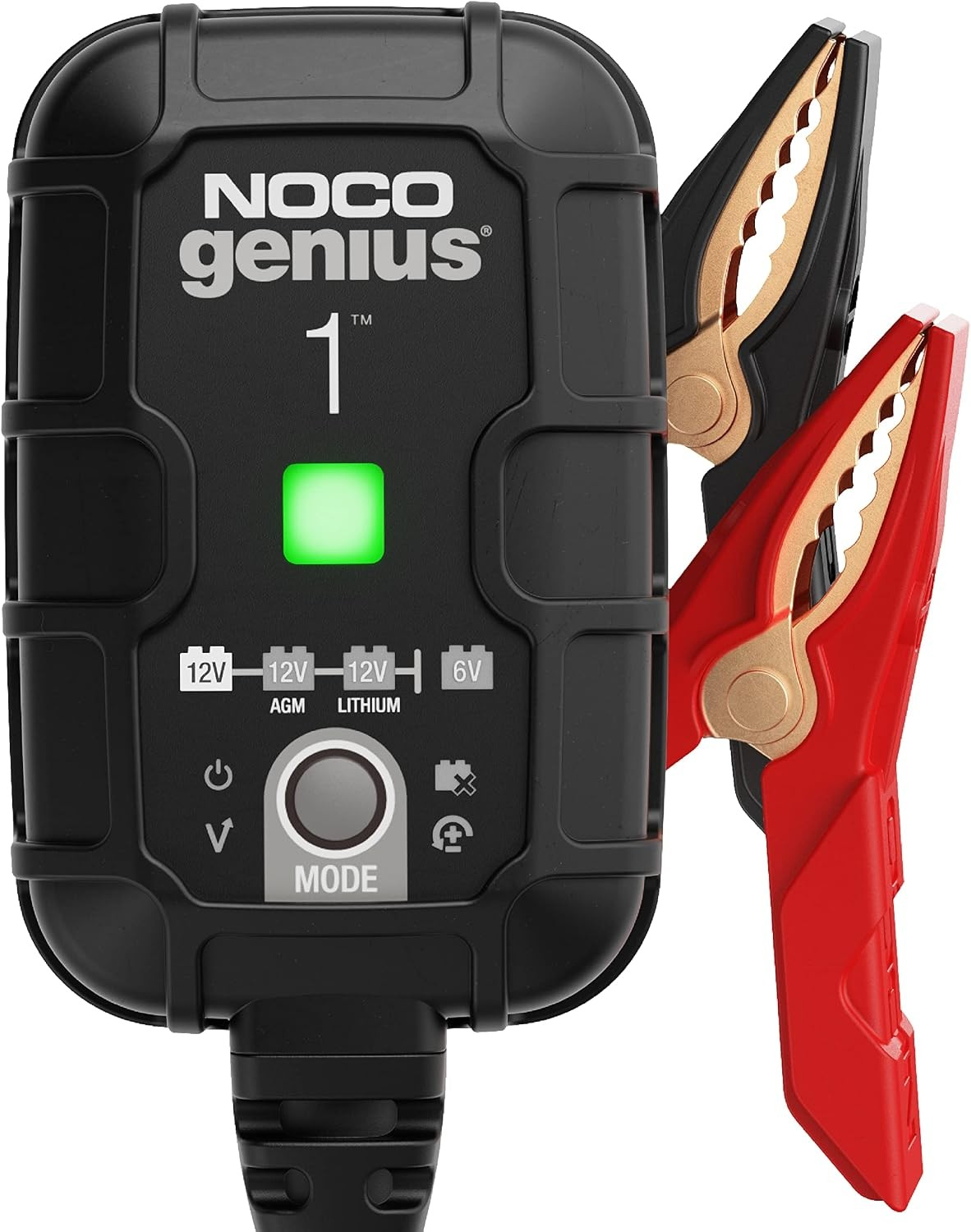 NOCO GENIUS1 | Keeping a parked car or bike topped up | 6/12 V, 1 A | Charges up to 30 Ah, maintains all sizes | Check Price |
 NOCO GENIUS5 | Car and truck owners who also need real charging | 6/12 V, 5 A | Up to 120 Ah | Check Price |
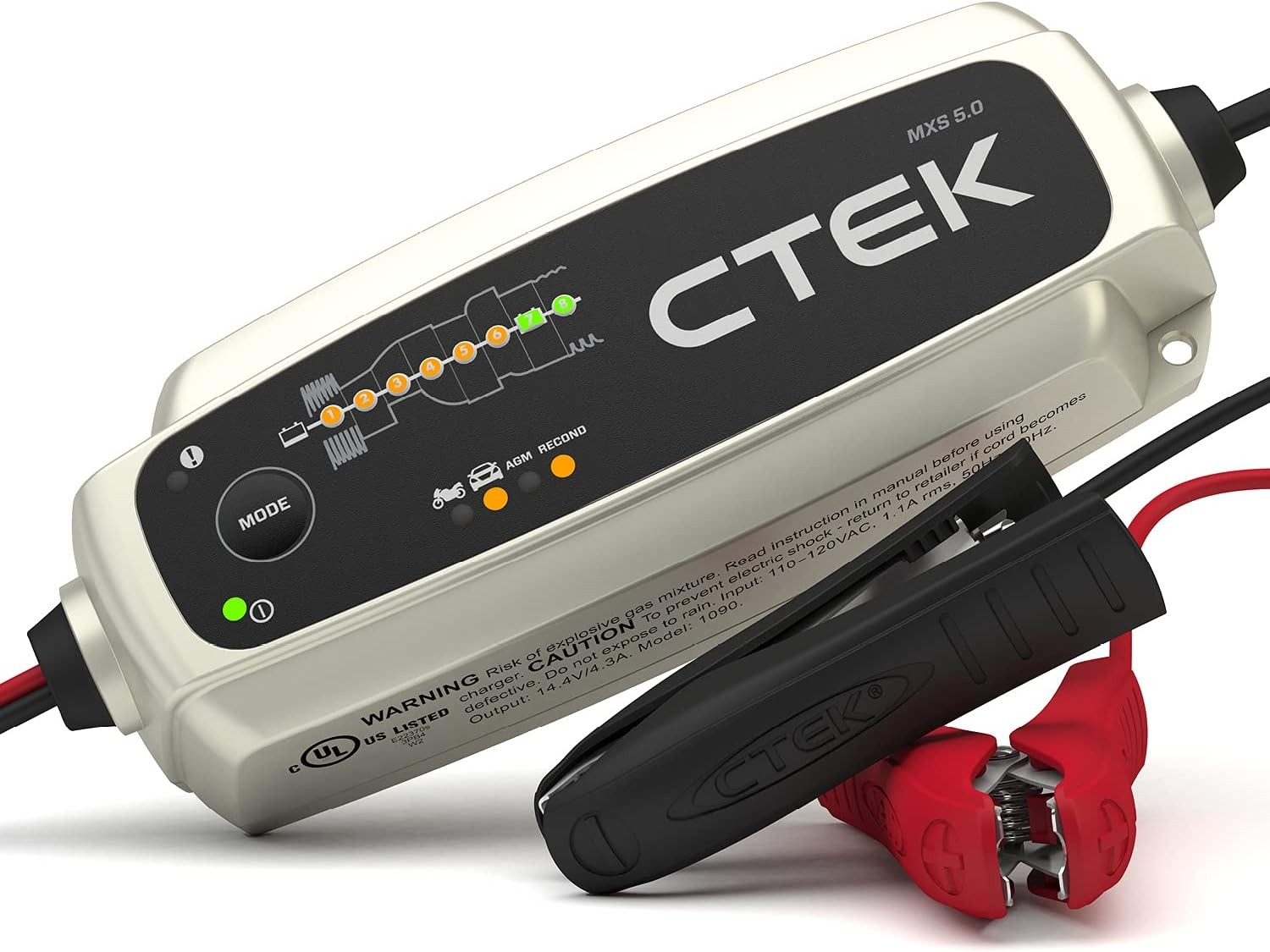 CTEK MXS 5.0 (40-206) | AGM and stop-start cars, stored classics | 12 V, 4.3 A | 1.2 to 110 Ah, maintains up to 160 Ah | Check Price |
For motorcycles and seasonal toys: Battery Tender Junior
The Battery Tender Junior has been the default answer in motorcycle shops for years, and it still makes sense for small batteries that sit all winter.
The 021-0123 model outputs 12 V at 750 mA and is rated for lead-acid, AGM, gel and sealed maintenance-free batteries from 3 to 30 Ah. That covers motorcycles, ATVs, riding mowers and personal watercraft.
It ships with both alligator clips and a ring-terminal cable. Bolt the ring terminals on in the fall, plug in whenever the bike is parked, and forget about it until spring. Battery Tender backs it with a 5-year limited warranty.
Good to know: this version is not for lithium batteries, and Battery Tender itself points owners of bigger batteries or cars with heavy parasitic draw to its larger Plus model.
Storing a bike for winter? Battery Tender lists the Junior at $44.95 on its own site. Check what Amazon is asking today.
See the Battery Tender Junior →The small, cheap insurance policy: NOCO GENIUS1
If your goal is simply to stop a parked car from going flat, the GENIUS1 is about as small and inexpensive as a good smart charger gets. NOCO lists it at $29.95.
It delivers 1 amp at 6 or 12 volts and works with flooded, AGM, gel, EFB, maintenance-free and lithium batteries. NOCO rates it for charging batteries up to 30 Ah and for maintaining batteries of any size, so it will happily keep a car battery topped up even though it would take a long time to refill a dead one.
The leads are long, too: NOCO quotes 106 inches of DC cable including the clamps, which helps when the outlet is on the far side of the garage. The unit weighs 0.77 lb and comes with eyelet connectors for a permanent hookup.
Second car that mostly sits? The GENIUS1 is a cheap way to make sure it starts next time.
Check Today’s Price →The one most households should buy: NOCO GENIUS5
If you only buy one charger for a garage with cars in it, make it a 5-amp model. The GENIUS5 can recover a run-down car battery in a reasonable time and then sit on maintenance all winter.
NOCO rates it at 5 amps for 6 V and 12 V batteries up to 120 Ah, including lead-acid types and lithium. Its thermal sensor adjusts charging to ambient temperature, and NOCO says it starts charging batteries as low as 1 volt, with a Force Mode for batteries below that.
It is IP65 rated, weighs 1.5 lb and carries a 3-year limited warranty. NOCO’s list price is $69.95.
Good to know: 5 amps is overkill for a tiny motorcycle battery. If small batteries are all you have, the GENIUS1 or Battery Tender Junior is the better fit.
One charger for every car in the garage? The GENIUS5 charges and maintains, with enough current to rescue a flat car battery.
View the GENIUS5 on Amazon →For AGM batteries and stored classics: CTEK MXS 5.0
CTEK has a strong following with classic-car owners and European-car people, and the MXS 5.0 is the model you see most often hanging on garage walls.
The North American version (40-206) is a 12 V-only charger that puts out 4.3 A. CTEK rates it for batteries from 1.2 to 110 Ah and for maintenance charging up to 160 Ah, covering wet, maintenance-free, Ca/Ca, AGM, EFB and gel types. It has built-in temperature compensation and an eight-step charging program.
CTEK backs it with a 5-year warranty, and the unit is IP65 rated.
Good to know: it doesn’t support lithium batteries or 6 V systems. If you have either, the NOCO GENIUS5 is the more flexible choice.
Laying up a car for the winter? The MXS 5.0 is built for long, unattended maintenance on lead-acid and AGM batteries.
Check Price on Amazon →Hooking one up safely
Read the charger’s manual first, because the exact sequence varies. The basics are the same for all of them:
- Work in a ventilated space and wear eye protection. Lead-acid batteries can give off hydrogen while charging.
- Make sure the charger is unplugged from the wall before you attach the clamps.
- Connect the red clamp to the positive (+) terminal. Then connect the black clamp where the manual says: usually the negative terminal, or a solid ground on the chassis or engine block, away from the battery.
- Plug in, select the battery type if the charger asks, and let it run.
- To disconnect, unplug from the wall first, then remove the clamps in reverse order.
Keep the charger off the battery itself and away from fuel or anything that might drip. Never try to charge a frozen, cracked or swollen battery. Replace it.
Quick decision checklist
- Daily driver, healthy battery, no long gaps? You probably don’t need one.
- Motorcycle, mower or boat stored for winter? A small maintainer like the Battery Tender Junior or GENIUS1.
- Car that sits for weeks? The GENIUS1 keeps it topped up. Want to revive flat batteries too? Go GENIUS5.
- AGM battery in a stored classic or European car, 12 V only? The CTEK MXS 5.0 is a proven choice.
- Lithium battery anywhere in the fleet? Stick with the NOCO models.
A maintainer is one of the cheapest bits of car insurance you can buy. Fifteen seconds to clip it on beats a morning waiting for a jump.
Spending more time under the car? Read Mechanic Creepers and Shop Stools for Under-Car Work.
Another trunk essential: Best Portable Tire Inflators for Your Car.
Battery light or check engine light after a jump? Read the codes first: Best OBD2 Scanners for Home Mechanics.
While the hood is up, run through a monthly coolant, brake and washer fluid check.
Related: Best Dash Cams Under $100
Related: Using a Multimeter to Track Down Car Electrical Problems
Related: Storing a Car for Winter: Battery, Fuel and Tires