Pressure Washer vs Garden Hose for Washing Your Car
Reading Time: 6minutesPressure washer or garden hose for your car? We compare cleaning power, paint safety, foam, setup and cost, plus the nozzle rules that keep paint safe.
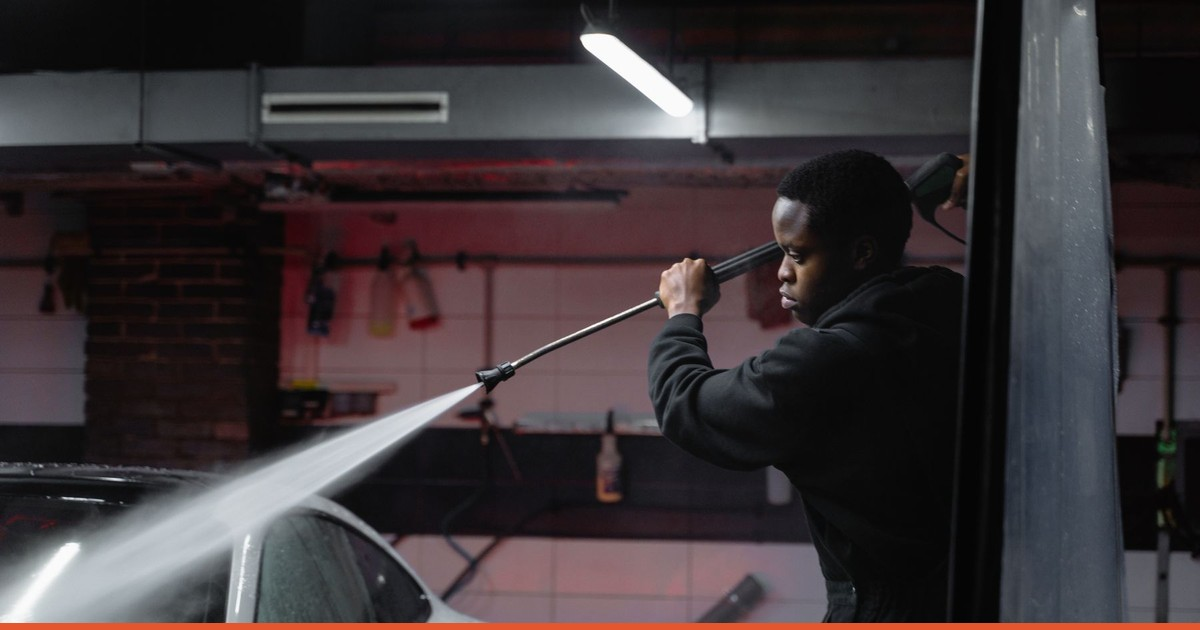
Rinsing a car with an electric pressure washer. (Photo: Tima Miroshnichenko, Pexels)
Reading Time: 6minutes
Saturday morning, the car is wearing a week of road film and a fresh coat of pollen, and there are two things in the garage that could deal with it: the garden hose that came with the house, or a pressure washer that has been eyeing you since you bought it for the patio. Plenty of people swear by one and refuse to let the other near their paint.
Both camps have a point. A pressure washer is faster and better at shifting grime, but it can also strip wax, push water past seals and chip edges if you get careless. A hose is gentle and always ready, but it leaves more of the scrubbing to your wash mitt, and that is where swirl marks come from. Here is how they compare, round by round.
Disclosure: GarageWise is reader-supported. As an Amazon Associate we earn from qualifying purchases, at no extra cost to you.
This is the round people buy pressure washers for. A wide fan of water at real pressure lifts loose dirt, salt and brake dust off the surface before you ever touch it with a mitt. Wheel wells, rocker panels and the lower doors, where road grime bakes on, come clean far faster than with a hose.
A hose with a good nozzle still removes loose dust and pollen, and for a car that gets washed every week or two that may be all the rinse it needs. Where it falls short is anything stuck: you end up relying on the mitt to scrub it off, and dragging grit across paint is the main way people put fine scratches into their clear coat.
Winner: pressure washer. The less dirt is left on the car when the mitt goes on, the fewer scratches you make.
Round 2: Paint, trim and seals
Here the hose wins without trying. You cannot hurt a car with mains water pressure. A pressure washer can, and the damage usually comes from technique, not the machine. Automotive writers at Jalopnik put the comfortable range for painted panels at about 1,200 to 1,900 PSI, and they are clear that pressure is only part of it: nozzle angle and distance matter just as much.
The rules that keep you out of trouble are simple. Use a 25 or 40 degree tip on paint. Leave the 0 and 15 degree tips and the turbo nozzle in the box, because they focus the water into a cutting jet. Start about 12 to 18 inches from the panel and only move closer if the dirt really will not shift. Keep the wand moving, and give rock chips, peeling clear coat, badges, rubber seals and tire sidewalls a wide berth.
Winner: garden hose. A pressure washer is safe in careful hands, but the hose is safe in anyone’s.
Round 3: Foam and the pre-wash
Foam is not just for show. A thick layer of car shampoo sits on the paint, softens dirt and lets it rinse off before the contact wash. Both camps can do it, with different gear.
On a pressure washer, a foam cannon screws onto the wand’s quick-connect and mixes shampoo, water and air into dense foam that clings to vertical panels. Most electric washers also come with a basic soap applicator, but a dedicated cannon makes much thicker foam.
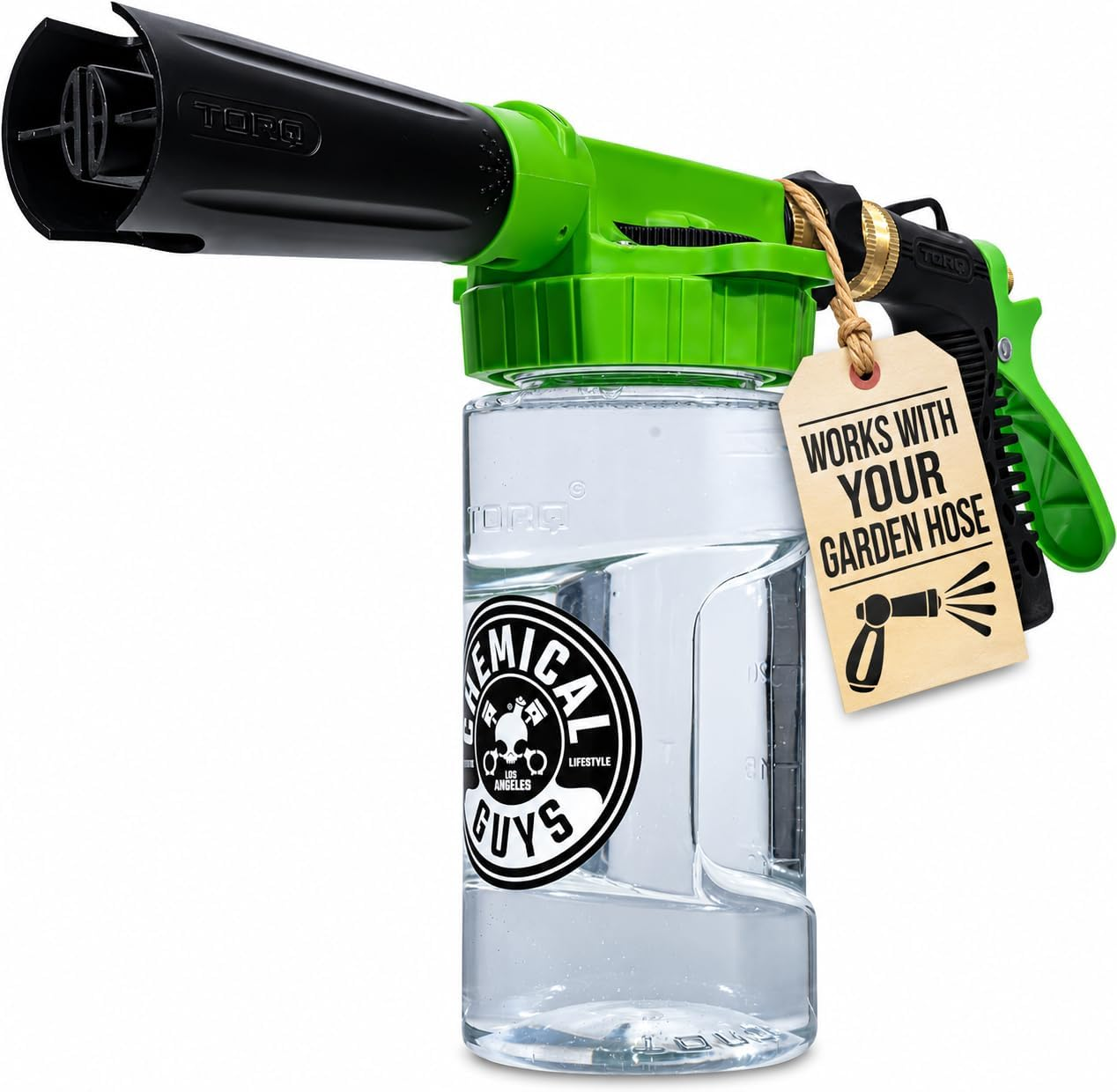
On a hose, a foam gun such as the Chemical Guys TORQ Foam Blaster 6 screws onto a standard garden hose and has a dial to set how much soap goes into the stream. The suds are wetter and run off sooner than cannon foam, but they still add lubrication for the mitt and need no extra machine.
Chemical Guys TORQ Foam Blaster 6 connects to a regular garden hose
No pressure washer, no problem. A hose foam gun gets you a proper pre-soak with the gear you already own.
Winner: pressure washer, but only once you add a foam cannon. A hose foam gun closes much of the gap for a fraction of the hassle.
Round 4: Setup, storage and cost
A hose is already on the wall. A pressure washer needs a GFCI-protected outdoor outlet, a hose feed, a high-pressure hose, the wand and a place to keep it all. Electric models are far easier than gas ones: no oil, no fuel and no pull cord, which suits the short, frequent jobs car washing involves.
Two electric models that show up in a lot of driveways:
Greenworks 1900 PSI Electric Pressure Washer
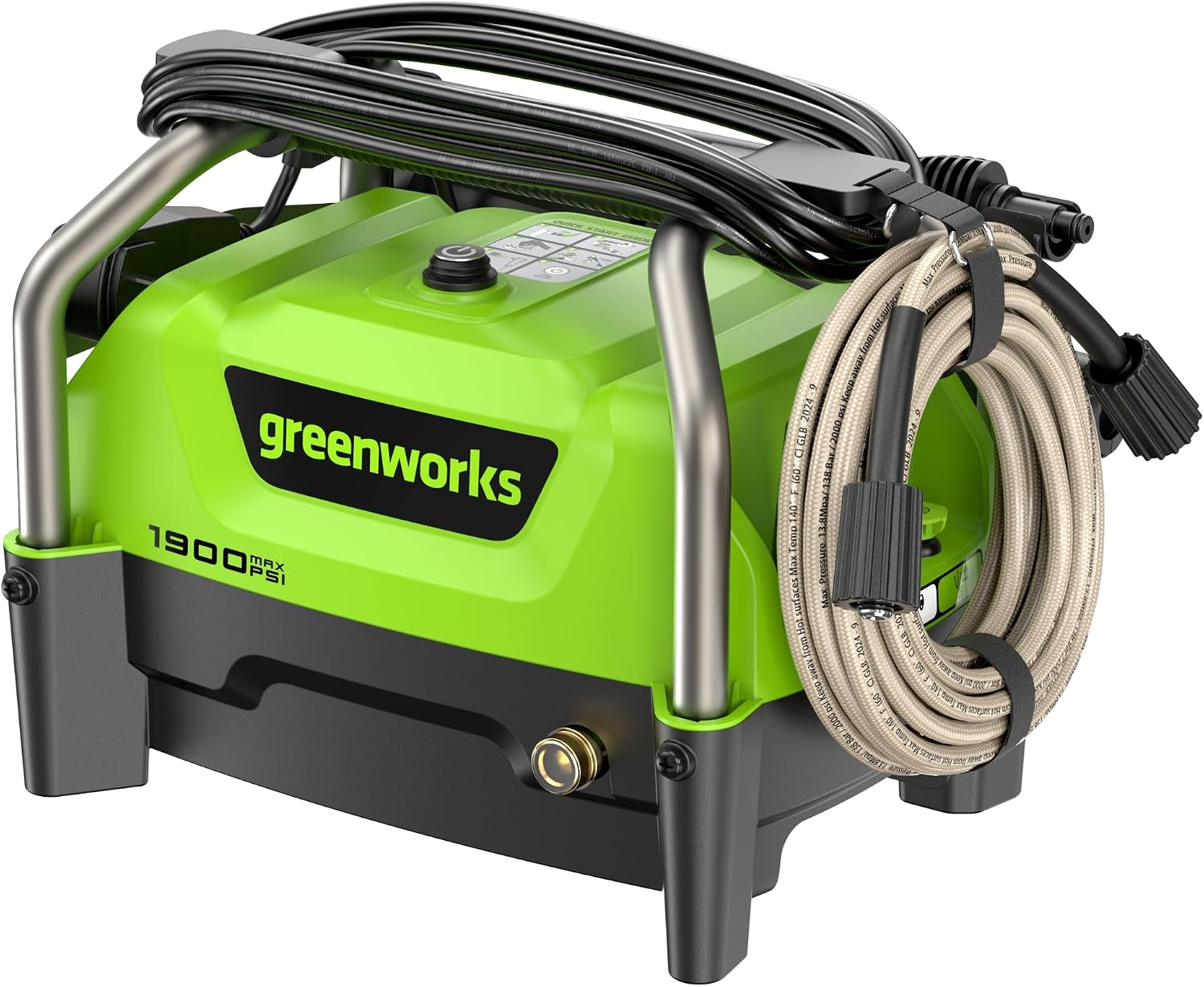
Greenworks rates this compact unit at 1,900 PSI max and 1.2 GPM, aimed at light, residential jobs like cars, bikes and patio furniture. It ships with 25 and 40 degree nozzles, a turbo nozzle, a soap applicator and a 20 ft hose on a 1/4 inch quick-connect system, plus a 35 ft cord with a GFCI plug. Its max pressure sits right at the top of the paint-friendly range, which is exactly what you want for a car. It was listed at about $100 on Amazon when we checked, and Greenworks backs it with a 3-year limited warranty.
Greenworks 1900 PSI electric pressure washer, 1.2 GPM
Want a washer sized for cars, not concrete? The Greenworks 1900 PSI stays inside the range detailers recommend for paint.
The SPX3000 is the bigger, wheeled option. Sun Joe lists 2,030 PSI working pressure (2,500 PSI max) and 1.2 GPM, five quick-connect tips (0, 15, 25, 40 degrees and soap), a 34 inch stainless lance and a 20 ft high-pressure hose. Its party trick is two onboard 0.9 litre detergent tanks, so you can keep car shampoo in one and a deck or siding cleaner in the other.
The trade-off for the extra muscle is discipline: on the car, stick to the 25 or 40 degree tip and keep your distance. If the patio and driveway are also on your list, this is the more useful machine overall.
Sun Joe SPX3000 with its five quick-connect tips
Washing the car and the patio? Two detergent tanks and five tips make the SPX3000 a good all-round house machine.
Winner: garden hose. Free, already plumbed in and zero storage. If you buy a washer, buy it for everything else around the house too.
Round 5: Where and when you wash
Your situation can settle the argument before the gear does. If you live in an apartment or wash in a shared parking area, a pressure washer may simply not be an option, and a hose (or a waterless wash) is what you have. Some towns also restrict hose use or runoff during dry spells, so it is worth checking local rules before you plan a weekly foam party.
Winter flips things the other way. Salt and slush pack into wheel wells and underbody seams, and a pressure washer with a wide tip is the practical way to flush them at home. Just store the machine where it cannot freeze, or drain it carefully if it lives in an unheated garage.
Winner: tie. It depends on where you park and what the weather throws at you.
The verdict
A pressure washer is the better tool for actually getting a car clean, especially a dirty one, and it pays off most when it is paired with a foam cannon and a careful two-bucket wash. A garden hose is the safer and simpler tool, and with a foam gun it does a perfectly good job on a car that is kept up regularly.
Pick the hose if you wash often, rent, have limited storage or simply do not want another machine. Add a foam gun and a good wash mitt.
Pick a pressure washer if the car regularly comes home muddy or salty, you also want to clean a patio or siding, and you are happy to follow the nozzle and distance rules.


 Foam gun
 Check Price