Best Cordless Car Polishers for First-Time Paint Correction
Reading Time: 7minutesThe cordless DA polishers worth buying for your first paint correction, from Milwaukee, DEWALT, Makita and RYOBI, plus how to do a safe first pass.
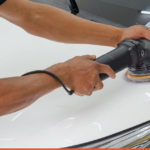
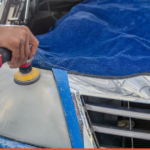
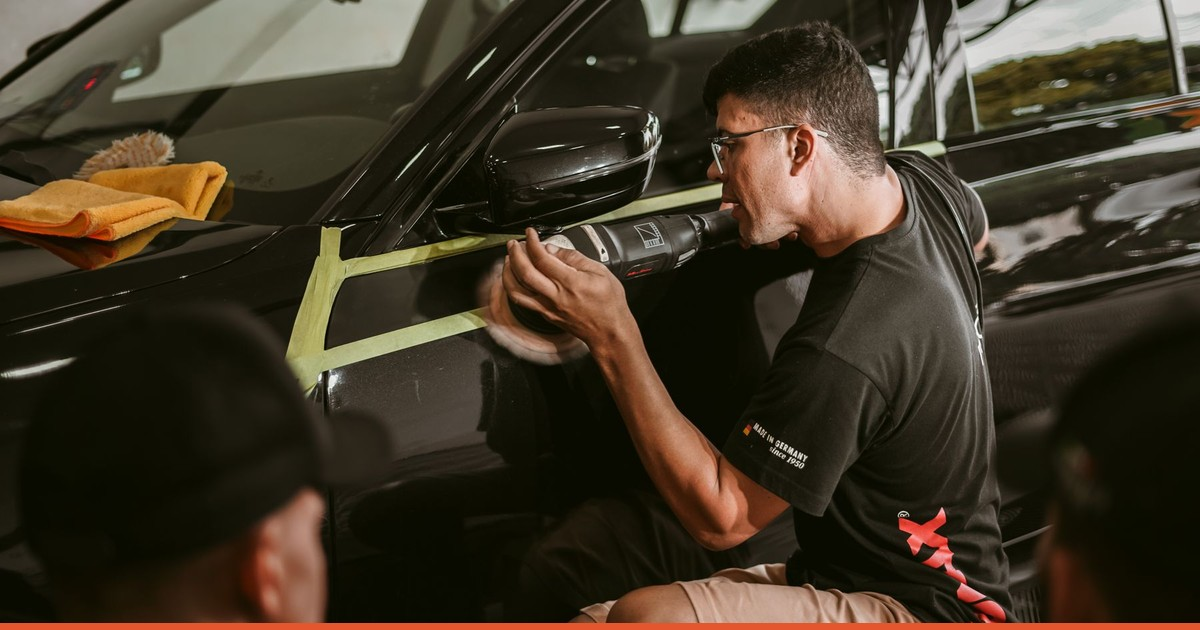
Paint correction in progress, trim taped off and working one small section at a time (Photo: Geancarlo Peruzzolo, Pexels)
Reading Time: 7minutes
You wash the car, the sun comes out, and there they are: fine circular scratches all over the hood, a few deeper marks by the door handles, and a haze that no amount of wax seems to hide. That is the moment most people start looking at polishers.
The good news is that a modern dual action (DA) polisher makes paint correction a realistic weekend job for a beginner. The even better news is that the cordless ones are now strong enough to do it without dragging an extension cord over the roof and across fresh paint. Here are the cordless polishers worth a look, and how to use one on your first car without making things worse.
Disclosure: GarageWise is reader-supported. As an Amazon Associate we earn from qualifying purchases, at no extra cost to you.
A rotary polisher spins the pad on a fixed axis. It cuts fast, but it also builds heat quickly and can burn through clear coat on an edge in seconds. A dual action, or random orbital, polisher spins and oscillates at the same time, which spreads the work out and makes it much harder to damage the paint. That is why every pick here is a DA style tool and why we would not hand a rotary to a first-timer.
Cordless matters more than it sounds. With a corded polisher, the cable has to go somewhere, and it usually ends up draped over your shoulder or sliding along a panel you just finished. A battery tool lets you walk around the car, kneel at the rocker panels and work the roof without managing anything but the pad.
The trade-off is runtime. Polishing is a hard, continuous load, so plan on at least two batteries and swap them as you go. Obsessed Garage, a detailing shop that switched its own work to cordless, recommends a pair of Milwaukee XC 6.0 packs for exactly this reason.
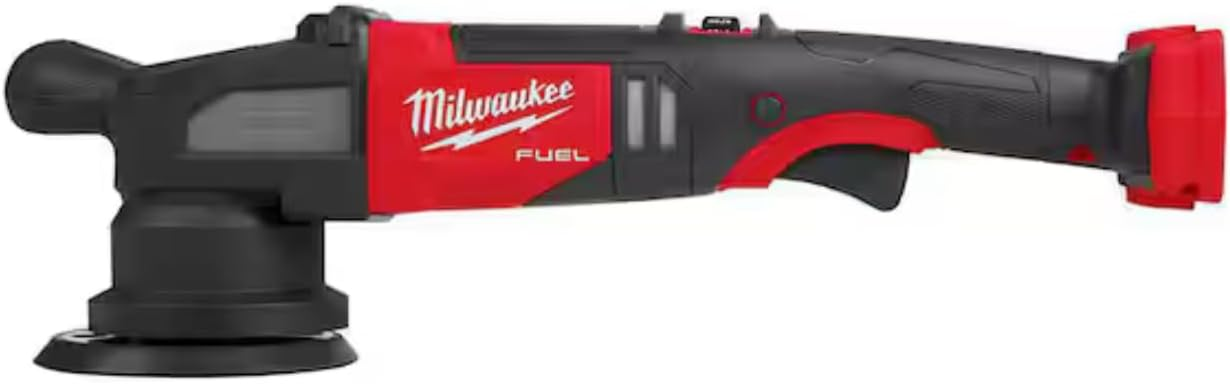
1. Milwaukee M18 FUEL 15mm Random Orbital Polisher (2684-20)
Milwaukee M18 FUEL 15mm random orbital polisher (tool only)
This is the one we would point most first-timers toward. Milwaukee calls it the most powerful cordless polisher on the market, and its main trick is a motor that holds speed under load, so the pad keeps turning when you lean on it instead of stalling on a curved panel.
The details are friendly for beginners. There is an 8-position speed dial running from 2,650 to 5,100 RPM, a variable-speed trigger for easing in, and a lock-on button for long passes. It ships with a 5-inch backing plate, weighs 5.16 lb as a bare tool, and Milwaukee gives it a 3-year limited warranty.
One small thing we like: Milwaukee lists 2.21 inches of clearance between the battery and the work surface, so a slipped hand does not put the battery pack into the door. If you later fall for long-throw polishing on big flat panels, the same family includes a 21mm version, but the 15mm is the easier one to learn on.
It was about $245 for the bare tool on Amazon when we checked. If you do not already own M18 batteries, budget for two high-output packs and a charger.
Already have M18 batteries? Then this is the easiest way into real paint correction, with power that will not stall on you mid-panel.
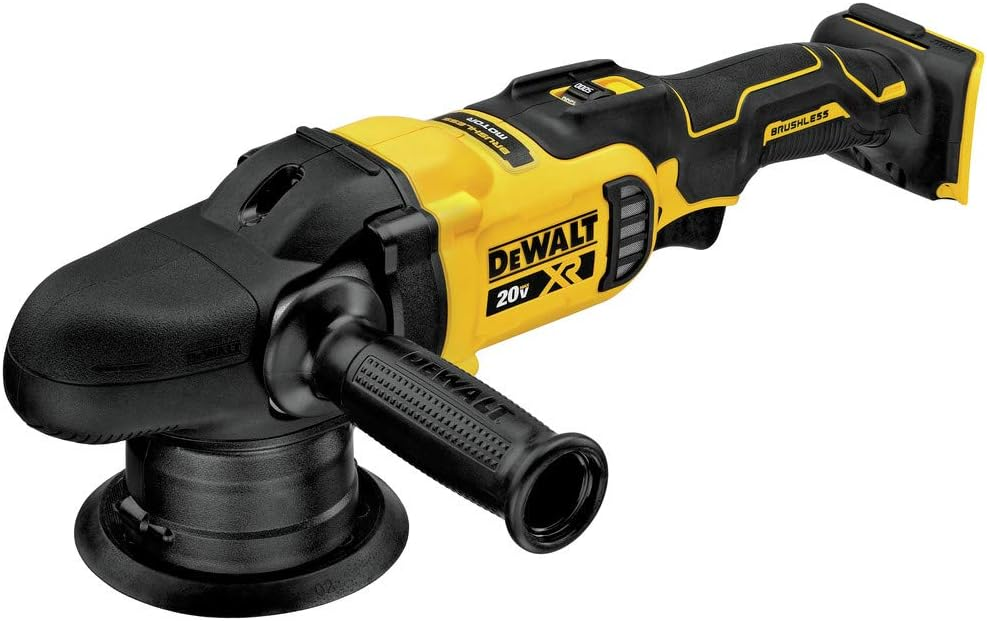
2. DEWALT 20V MAX XR 5-Inch Random Orbit Polisher (DCM848B)
DEWALT DCM848B 5-inch random orbit polisher (tool only)
If your garage is already full of yellow batteries, the DCM848B is the sensible choice. It is a brushless random orbit polisher with a 5-inch backing plate and a speed range of 2,000 to 5,500 OPM, controlled by both a dial and the trigger.
DEWALT gives you two ways to hold it: a front grip or a side handle. On a polisher this matters more than you would think, because lower panels and bumpers ask for very different hand positions. The gear case also has a rubber overmold, which helps if the head brushes a panel by accident.
It was listed at about $309 for the bare tool when we looked, so it is not the budget pick. What you are buying is the convenience of sharing batteries with tools you already own.
Running DEWALT 20V already? Skip a second battery platform and polish on the packs you have.
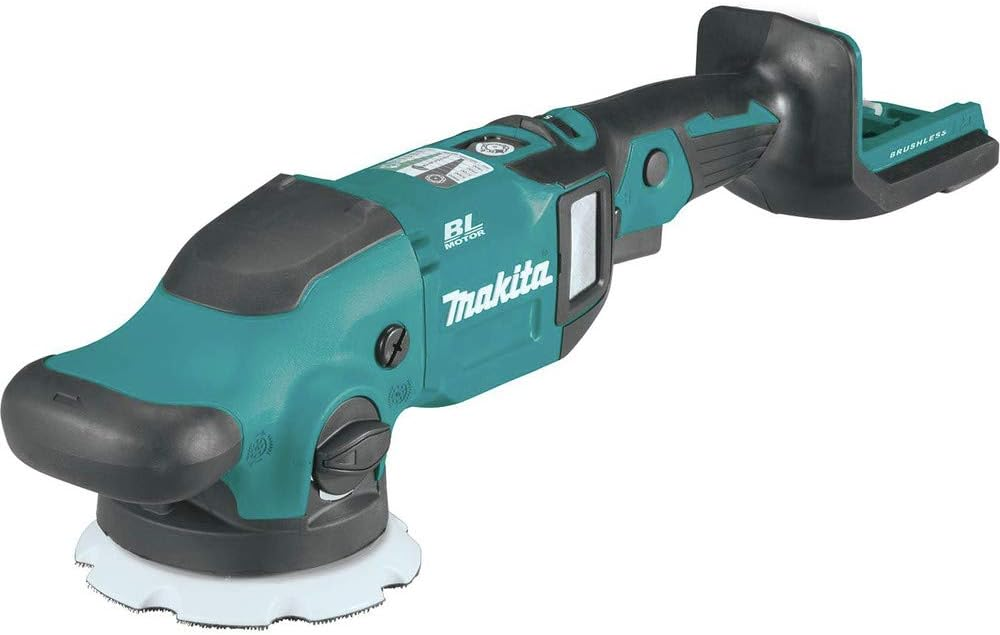
The Makita is the most flexible tool on this list. It takes 5-inch or 6-inch pads and lets you choose between free spin random orbit, which is what a beginner wants, and forced rotation, which cuts harder and behaves more like a geared polisher.
It also has a dual power mode. Makita describes high power as corded-level output for correcting and low power as the setting for longer runtime when you are finishing. Speed is variable up to 6,800 OPM in random orbit mode.
Our advice: leave it in free spin for your first few cars. Forced rotation is useful for heavy defects, but it removes more clear coat and gives you less margin for error. Prices for this one move around a lot, so check before you buy.
On Makita LXT and want room to grow? Start in free spin, then switch to forced rotation once you know your paint.
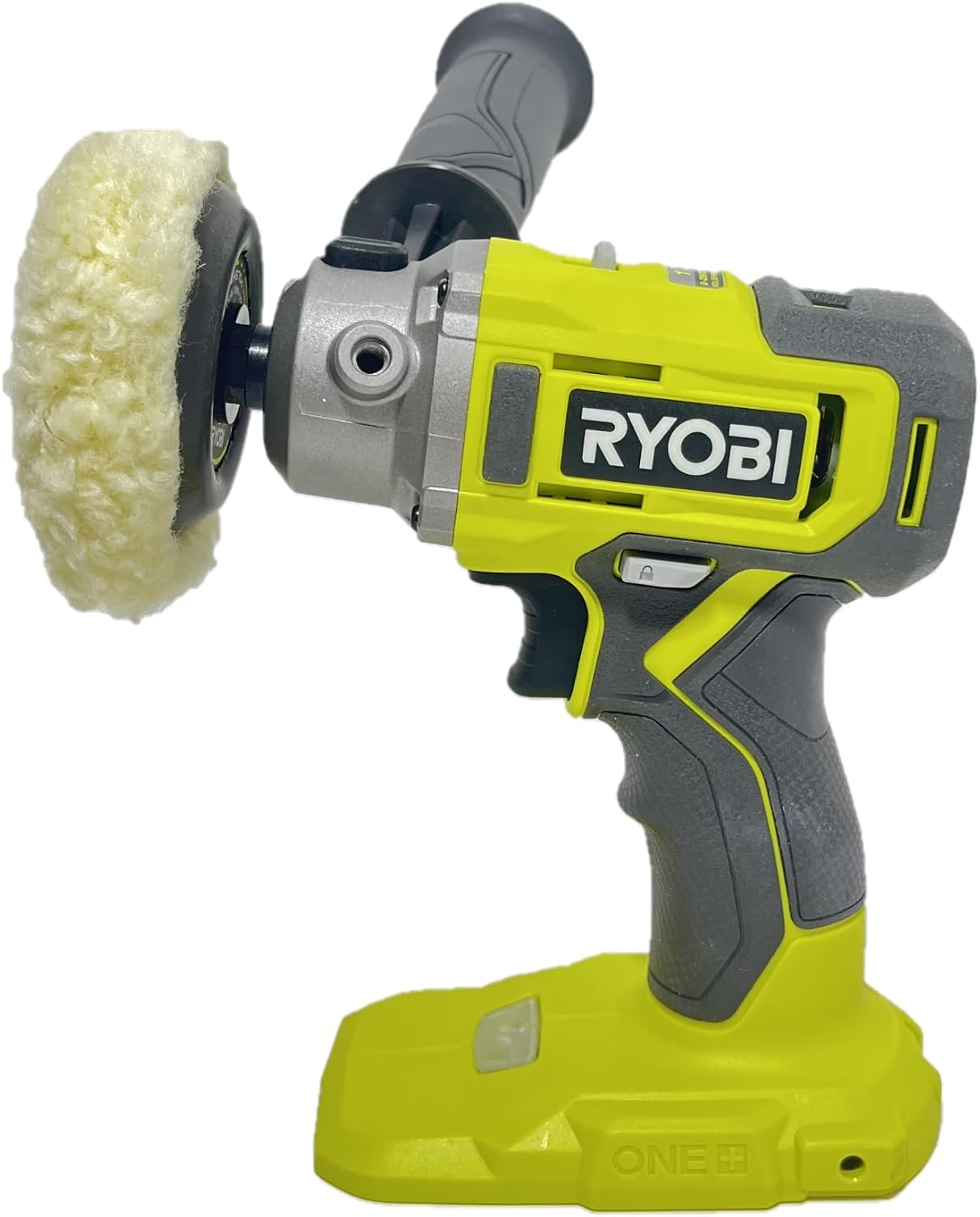
This is not a full-car polisher, and we would not try to correct a whole hood with a 3-inch pad. It earns a spot because every car has areas a 5-inch pad cannot reach: around badges, door handles, mirror housings, A-pillars and the narrow strip below the windows.
The PBF102B is compact, variable speed and runs on any ONE+ 18V battery. It was about $100 as a bare tool. For a lot of hobbyists it makes a good second tool after the main polisher, and Obsessed Garage keeps a small-pad polisher in its kit for the same jobs.
Tight spots driving you mad? A 3-inch detail polisher gets into the corners your big pad skips.
The polisher is only half of the kit. You will also need:
Foam pads in at least two grades, a cutting pad and a polishing or finishing pad, sized to your backing plate. Browse 5-inch DA pads
A compound and a finishing polish from the same brand, so they are designed to work together.
Painter’s masking tape for rubber trim, plastic and panel edges.
A stack of clean microfiber towels for wiping residue and checking your work.
Eye protection. Polish slings, and you will be looking straight at the pad.
Before any of that, the paint has to be clean. Wash it properly, then decontaminate it with a clay bar so you are not grinding grit into the finish. Our guide to the order of clay, polish and wax walks through the sequence.
How to do your first correction without hurting the paint
Start with a test spot. Pick a 2 ft by 2 ft area on a flat panel. Try the least aggressive combination first: finishing polish on a polishing pad. Only step up to compound and a cutting pad if the gentle combo does not remove enough.
Prime the pad. A few small dots of product on the pad, spread on the panel at low speed before you turn it up. Too much product just makes a mess.
Keep the pad flat. Tilting it onto its edge concentrates heat and cut in one spot. Let the tool do the work with light, steady pressure.
Work slow, overlapping passes. Move side to side, then up and down, across your small section. Wipe and inspect with a light before moving on.
Stay off edges and body lines. Paint is thinnest there. Tape them and come back with a smaller pad, or simply leave them.
Clean the pad often. A pad loaded with old polish and paint residue cuts unevenly. Brush it out or swap to a fresh one.
Then protect the result. Polish removes defects, but it leaves the paint bare. Finish with a wax, sealant or coating, and change how you wash the car so the swirls do not come straight back. Our guide to washing without scratching the paint covers the two-bucket routine that keeps a corrected finish looking good.
Which one should you buy?
If you are starting from zero, the Milwaukee 2684-20 is the easiest recommendation: strong, controllable and simple to learn on. If you already own DEWALT 20V or Makita LXT tools, buy the polisher that matches your batteries, because the savings on packs and chargers are real. And whichever you pick, add a small detail polisher later if you find yourself fighting the tight spots.
Ready to get rid of the swirls? Pick the polisher that fits your batteries, start with a test spot and take it slow.


 Milwaukee M18 FUEL 15mm (2684-20)
 DEWALT 20V MAX XR DCM848B
 Makita XOP02Z
 RYOBI ONE+ PBF102B